Stage 16 — AI-Powered QA: Become the 100× Tester (the module)
Goal: turn AI from a novelty into your daily force-multiplier — know exactly what to learn before you implement it, what to automate, how to stack tactics into ~100× throughput, and how to do it safely. Stage 11: AI × QA is the hands-on MCP + Playwright + evals primer; this module is the strategy, the prerequisites, and the adoption playbook. Field notes from running AZAI Labs (build with agents, not headcount).
1. What “100×” actually means (honest math)
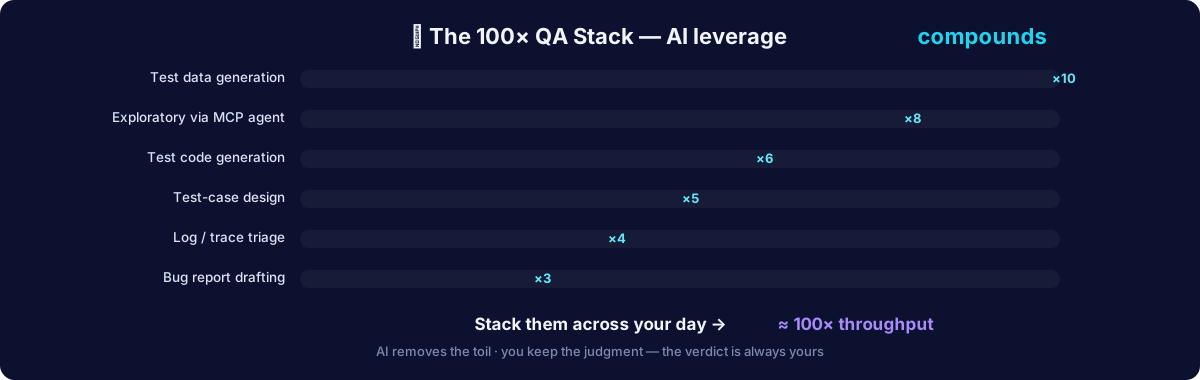
You will not run one magic tool that’s 100× faster. You’ll apply many 3–10× tactics across your day, and they compound: faster test design × instant test data × agent-driven exploration × generated test code × instant log triage. Ten activities each 2–10× faster is a different job, not a faster version of the old one. AI removes the toil; your judgment becomes the scarce, valuable part.
The mental model:
Old QA = do the work + judge the work. · AI QA = direct the work + judge the work at 10× the volume.
2. 🧠 Before you implement AI — what QA MUST know first
Skipping this is why most AI-QA efforts produce confident garbage. AI amplifies whoever’s driving — a strong tester gets 100×, a weak one 100×’s their mistakes. Master these before you automate anything with AI:
| Prerequisite | Why it’s non-negotiable | Where to learn |
|---|---|---|
| Test design & risk thinking | You must judge AI output — spot the missing boundary, the weak assertion, the wrong oracle. AI proposes; you decide | Stage 1, Stage 4 |
| What “correct” looks like (oracles) | AI can’t tell you the right answer for your product — you supply the oracle | Stage 0 |
| Basic programming + CLI + Git | To run agents, read generated code, and commit it | Stage 14 |
| How LLMs work (high level) | Tokens, context windows, non-determinism, hallucination, temperature — so you know when to trust output and when not to | Stage 11 |
| Prompting fundamentals | Role + context + constraints + examples = usable output. Vague prompt = vague result | §7 below |
| The stack: MCP, an AI client, Playwright, an eval tool | The actual tools you’ll wire together | §5 below |
| Data & security hygiene | Never paste secrets, credentials, customer PII, or proprietary code into a prompt unless the tool is approved for it. Know your company’s AI policy | Stage 13 |
| Verification discipline | AI drafts, you decide. Every AI artifact is a draft until you’ve verified it | everywhere |
✅ Readiness check — you’re ready to implement AI when you can:
- Design a strong test suite from a vague requirement without AI
- Look at an AI-generated test and say precisely why an assertion is weak
- Run a script from the terminal and commit it with Git
- Explain hallucination and non-determinism in one sentence each
- Write a prompt with role, context, constraints, and an example
- State what data you must never put into a prompt
3. 🗺️ What AI can automate across the QA lifecycle
| QA activity | AI leverage | Tool | Your (human) role |
|---|---|---|---|
| Requirement/AC review | Flag ambiguity & gaps before coding | any LLM | Decide what’s actually a gap |
| Test-case design | Generate EP/BVA/negative/edge cases | LLM + your prompt | Prune, prioritize, add domain risk |
| Test data | Unicode/RTL/boundary/malformed sets instantly | LLM | Confirm realism & privacy |
| Exploratory testing | Agent walks the app via MCP | Playwright MCP + Claude Code/Cursor | Set the charter; judge findings |
| Test code generation | Draft Playwright/API specs from a description or recording | codegen + agent | Review assertions (the job) |
| Self-healing automation | Auto-fix drifted locators | Playwright healer, Testim, Mabl | Approve/reject the fix |
| Bug reports | Turn messy notes into clean reports | LLM + your template | Verify repro & evidence |
| Log / trace / HAR triage | Explain stack traces, find root cause fast | LLM | Confirm the hypothesis |
| Regression selection | “Given this diff, what’s most at risk?” | LLM | Final risk call |
| Visual testing | AI diffing that ignores noise | Applitools, Percy | Approve intended changes |
| Docs & test summaries | Draft summaries, coverage notes | LLM | Fact-check |
| Testing AI features | Build eval sets, LLM-as-judge, red-team | promptfoo, DeepEval | Own the quality bar |
4. ⚡ The 100× speed playbook (stack these)
Each tactic below, with how to trigger it. Do them daily until they’re reflexes.
- Instant test design (×5). Paste the story + your draft cases: “Act as a senior QA. What conditions am I missing — boundaries, states, concurrency, failure modes? Return a table.” Keep what survives your judgment.
- Instant test data (×10). “Generate 40 signup records covering locale, length, format, unicode/RTL, and injection edge cases, as CSV.”
- Agent-driven exploration (×8). MCP: “Open staging, explore checkout with expired cards and stacked coupons, report anything broken.” Review its findings.
- Generated test code (×6).
npx playwright codegen, or ask the agent to emit a spec — then rewrite assertions to check the right things. - Log/trace triage (×4). Paste the failure: “Likely root cause? What should I check next?”
- One-read bug reports (×3). Notes + template → clean report; you verify repro and attach evidence.
- Requirement review (×5). “List every ambiguous or untestable statement in this user story.”
- Regression targeting. Feed the changelog/diff: “Which of these 40 cases are most at risk from this change?”
- Docs & summaries. Draft the test summary report; you fact-check and sign the recommendation.
- Evals for AI features. Stand up a promptfoo set so every prompt/model change is scored automatically.
The compounding rule: don’t chase one giant automation. Win 30 minutes here, an hour there, all day — that’s the 100×.
5. 🧰 The modern AI-QA stack (2026)
| Layer | Tools |
|---|---|
| AI client (the cockpit) | Claude Code · Cursor · Claude/ChatGPT web |
| Browser control for agents | Playwright MCP + Model Context Protocol |
| Automation engine | Playwright (+ its planner/generator/healer agents) |
| Self-healing / low-code AI | Testim · Mabl · Functionize |
| Visual AI | Applitools · Percy |
| LLM evals (testing AI) | promptfoo · DeepEval · Langfuse · OpenAI Evals |
| AI security | OWASP Top 10 for LLM Apps |
Master depth, not breadth: one agentic workflow (MCP + Playwright) + one eval tool (promptfoo) beats ten tools used shallowly.
6. 🪜 The adoption ladder (crawl → fly)
| Rung | You can… | Prove it |
|---|---|---|
| Crawl | Use AI daily for test design, data, and bug reports — verifying every output | A week of AI-assisted artifacts |
| Walk | Run an MCP agent to explore a staging app and summarize findings | An agent exploration write-up |
| Run | Agent-generate a test suite, harden the assertions, run it in CI | A green AI-assisted pipeline |
| Fly | Build eval pipelines for AI features + design an AI-QA workflow your team adopts | A team playbook + eval dashboard |
7. 📝 Prompt patterns for QA (copy-paste library)
- Role + constraints: “You are a senior QA engineer. Given this requirement, list the test conditions I’m missing. Focus on boundaries, states, concurrency, and failure modes. Output a table; no prose.”
- Few-shot (teach your style): paste 2 of your best bug reports, then “Write the next one in exactly this format.”
- Self-critique (catch weak output): “Here are 10 tests you generated. Now act as a skeptical reviewer and flag which assertions are weak or only check ‘it loaded’.”
- Grounded (reduce hallucination): “Using ONLY the API spec below, list every endpoint’s negative test cases. If the spec doesn’t say, write ‘UNSPECIFIED’.”
- Explain-then-act: “First explain the likely root cause of this trace, then propose the next 3 checks.”
8. 🛡️ Guardrails & pitfalls (read before you scale)
- Hallucinated tests / weak assertions — AI loves asserting “page loaded.” Review every assertion; that review is the QA job.
- Over-trust — never sign off a release on unverified AI output. AI drafts, you decide.
- Non-determinism — the same prompt gives different output; pin versions, keep humans in the loop, and eval on every change.
- Security & privacy — no secrets/PII/proprietary code in prompts unless the tool is sanctioned. Follow your company’s AI policy.
- Agents in production — staging only, supervised, least-privilege. Auth reuse (storage state), not re-login loops.
- Flaky agent runs — treat like a new hire’s first week: watched, then trusted.
- Governance — log what AI generated, who reviewed it, and keep the audit trail.
9. 📊 Prove the speed-up (metrics)
If you can’t measure it, you can’t defend it (or get promoted for it):
| Metric | What it shows |
|---|---|
| Cycle time (idea → tested) | The headline speed-up |
| Time-to-first-test for a new feature | AI’s biggest early win |
| Coverage (cases/paths per sprint) | More surface, same headcount |
| Defect escape rate | Speed didn’t cost quality (the honest one) |
| Automation authored per week | Agent leverage, real |
| Flake rate | Guardrail on agent-generated tests |
10. 🗓️ 30 / 60 / 90-day adoption plan
- Days 1–30 (Crawl): AI on every test-design, data, and bug-report task. Build the prompt habit + your prompt library.
- Days 31–60 (Walk→Run): set up Playwright MCP; run agent explorations; agent-generate a small suite, harden it, put it in CI.
- Days 61–90 (Fly): build one promptfoo eval for an AI feature; write your team’s AI-QA playbook; start measuring cycle time & escape rate.
11. Where this takes your career
AI-fluent QA is the scarcest, best-paid corner of the field — companies find evaluators harder to hire than builders, and QA people are natural evaluators. Roles: AI QA Engineer · AI Evals Engineer · LLM Auditor · Agentic Automation Engineer (see Stage 11 §6 and the Capstone).
✅ Exercise
- Run the readiness check in §2 — honestly. Fix any gap before going further.
- Pick three tactics from §4 and use them on real work today; note the time saved.
- Stand up Playwright MCP and do one agent exploration; review its assertions and keep only the good ones.
- Build a 5-case promptfoo eval for any public chatbot feature.
🎓 Want this as a guided, hands-on course with feedback? It’s a track on AZADEMY.
Next → the Capstone: Get Hired as a Sr. QA · or the hands-on Stage 11: AI × QA