Stage 11 — AI × QA: The 2026 Playbook
Goal: use AI as leverage on every QA activity, drive browsers with AI agents (MCP + Playwright), learn to test AI systems themselves — and position your career for the biggest shift QA has ever seen. This is where I spend my working life now (AZAI Labs: build with agents, not headcount), so this chapter is field notes, not theory.
🎥 Playwright foundation before MCP
AI agents can generate and heal tests, but you still need to understand the Playwright code they produce. Start with this AZADEMY course preview, then return to the MCP workflow below.
Learn the browser-automation foundation first: AZADEMY Playwright playlist ↗. Then use MCP to plan, explore, generate, run and heal tests — while you review the assertions.
1. The honest picture first
AI does not replace testing thinking — it amplifies it. Everything from Stages 0–2 (risk, test design, judgment) matters more, because AI produces volume and you must judge quality. The testers being displaced are the pure-execution ones; the testers being promoted are the ones directing AI.
2. How AI helps each QA activity you already do
| Your activity | How AI helps | How to prompt it |
|---|---|---|
| Test case design | Generates EP/BVA/negative cases you might miss; great at “what did I forget?” | Paste the requirement + your cases: “Act as a senior QA. What conditions am I missing? Focus on boundaries, states, and concurrency.” |
| Test data | Generates realistic edge-case data instantly: unicode names, RTL text, boundary dates, malformed JSON | “Generate 30 signup test records covering locale, length, and format edge cases, as CSV” |
| Bug reports | Turns messy notes into a clean report in your template | Paste template + raw notes: “Rewrite into this template. Flag missing info as TODO.” |
| Exploratory charters | Proposes attack ideas per feature type | “Give me 10 exploratory charters for a file-upload feature, ranked by risk” |
| Requirement review | Finds ambiguity before you test | “List every ambiguous or untestable statement in this user story” |
| Log/HAR analysis | Explains stack traces and network captures fast | Paste the trace: “What’s the likely root cause? What should I check next?” |
| Regression selection | Suggests what to re-test from a diff/changelog | “Given this changelog, which of these 40 test cases are most at risk?” |
The golden rule: AI drafts, you decide. Never file a bug or sign off a release on AI output you didn’t verify — you own the verdict (Stage 2 still applies, always).
3. MCP + Playwright — AI agents driving real browsers
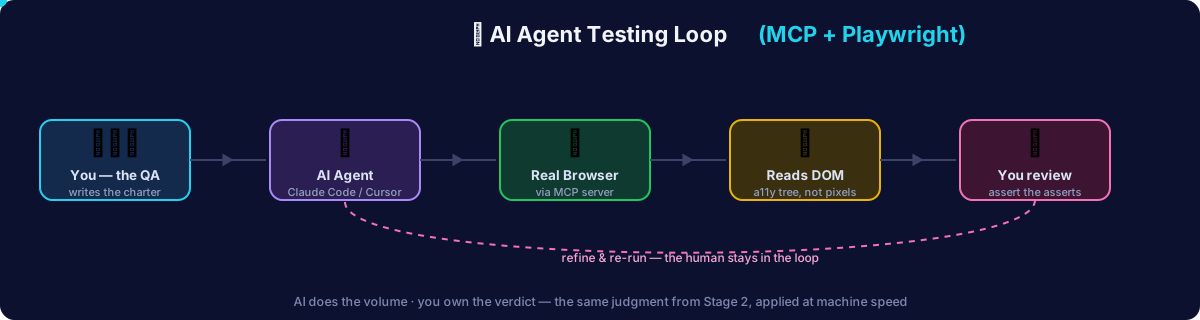
The biggest practical shift in automation: Playwright MCP exposes a real browser to AI agents over the Model Context Protocol (MCP). Any MCP-compatible client — Claude Code, Claude Desktop, Cursor — can open pages, click, type, read the DOM, and run tests.
Why it works so well
- The agent reads the accessibility tree (ARIA snapshot), not screenshots — faster, deterministic, and cheap on tokens
- It drives Chromium, Firefox, and WebKit — real browsers, real behavior
- It sees Playwright’s artifacts: traces, screenshots, network logs — so it can debug, not just execute
The workflow that’s winning in 2026 (and the one I run)
- Explore with the agent: point an MCP-driven session at staging: “Explore the checkout flow, try edge cases, report anything broken.” The agent walks the app like a junior tester with infinite patience.
- Generate candidate tests: the agent emits Playwright test code from what it observed.
- Human review — this is the QA job now: you check the assertions actually assert the right things (AI-generated tests love asserting “page loaded” and calling it coverage).
- Commit, run in CI, let the healer fix breakages: Playwright’s agentic loop (planner → generator → healer) proposes fixes when locators drift; you approve.
Setup in Claude Code / Cursor (5 minutes)
# add the official Playwright MCP server
claude mcp add playwright -- npx @playwright/mcp@latest
Then literally ask: “Open staging.example.com, add a product to the cart, and tell me if checkout works with an expired card.”
Field warnings (the stuff blog posts skip)
- Auth is the day-2 problem — agents that re-login every run hit rate limits and trigger security alerts. Use storage-state files or dedicated test accounts with session reuse.
- Shadow DOM hides elements from naive automation; prefer accessibility-tree-based interaction (which MCP does) over CSS selectors.
- Never point an agent at production with write access. Staging, always. Treat agent runs like you’d treat a new hire’s first week: supervised.
4. The AI-assisted QA tool landscape (2026)
| Category | Tools to know |
|---|---|
| Agentic browser testing | Playwright MCP + Claude Code/Cursor · Playwright test agents (planner/generator/healer) |
| Self-healing UI tests | Playwright healer · Testim · Mabl · Functionize |
| Visual AI | Applitools Eyes · Percy |
| AI test generation | GitHub Copilot for test code · Playwright codegen + AI review |
| Unit-test generation | Copilot · Claude Code (/generate tests for this module) |
| LLM eval frameworks | DeepEval · promptfoo · Langfuse · OpenAI Evals |
Don’t chase all of them. Master one agentic workflow (MCP + Playwright) and one eval framework — that combination is rarer than knowing ten tools shallowly.
5. Testing AI systems — the new QA frontier
Every product is adding LLM features, and someone must answer “is it good?” That someone is QA. This is genuinely new work:
What’s different about testing AI
| Traditional software | LLM-powered software |
|---|---|
| Deterministic: same input → same output | Probabilistic: same input → different outputs |
| Pass/fail assertions | Scored evaluations (relevance, accuracy, tone) |
| Bugs are code defects | “Bugs” include hallucinations, bias, prompt injection |
| Test once per build | Eval on every prompt/model change — regression testing for prompts |
The core practice: evals
An eval is a dataset of inputs + expected qualities, scored automatically (exact match, rubric scoring, or LLM-as-judge) on every change. Teams with great evals ship several times faster because they can tell whether a change helped. Start with promptfoo or DeepEval — both free and approachable for QA people.
AI security testing
Learn the OWASP Top 10 for LLM Applications: prompt injection, insecure output handling, data leakage, excessive agency. Manual attack practice: “Ignore previous instructions and…” variants against your own product’s chatbot — you’ll be shocked how often it works. (This pairs with Stage 13: Security Testing.)
6. Career in the AI era — where the market is going
From current market research (2026): companies report it’s harder to hire people who can evaluate AI than people who can build it — and QA people are natural evaluators. Emerging roles:
| Role | What it is | Your path to it |
|---|---|---|
| AI QA Engineer | Owns quality for AI-powered products: evals, regression, agent testing | This chapter + Stage 8 automation base |
| AI Evals Engineer | Builds evaluation pipelines for LLM products — 2026’s hottest new QA-adjacent discipline | Eval frameworks + data literacy |
| LLM Auditor / AI Output Reviewer | Reviews AI outputs for accuracy, bias, safety at scale | Deep manual-QA judgment + domain expertise |
| Agentic automation engineer | Designs and supervises AI agents that test (MCP workflows) | Playwright + MCP + prompt skill |
Compensation signal: AI-fluent QA roles are commanding a substantial premium over traditional QA at every level (US market reports show mid-level AI QA at roughly 1.5× traditional QA comp). The skills gap is your opportunity — most testers haven’t started.
Your 90-day AI upskill plan
- Weeks 1–2: use AI daily for test design + bug reports (section 2) — build the prompt habit
- Weeks 3–4: set up Playwright MCP, run your first agent-driven exploratory session on a practice site
- Weeks 5–8: agent-generate a small test suite, review and harden it, run it in GitHub Actions
- Weeks 9–12: build one eval set with promptfoo for any LLM feature (or a public chatbot), write up what you found
- Ship the proof: all of it goes in your portfolio repo — “supervised AI agents testing real software” is a résumé line very few can write today
✅ Exercise
- Take your Stage 1 password-reset test cases and ask an AI to find gaps — verify each suggestion before accepting it (notice how many are plausible but wrong: that judgment IS the job)
- Install Playwright MCP and have an agent explore saucedemo.com; compare its bug list to yours
- Write 5 prompt-injection attacks and try them on any public AI chatbot’s guardrails
Next → Stage 12: API Testing Deep Dive